
How to Read Horse Racing Form: A Punter’s Guide to the Racecard
 Available in US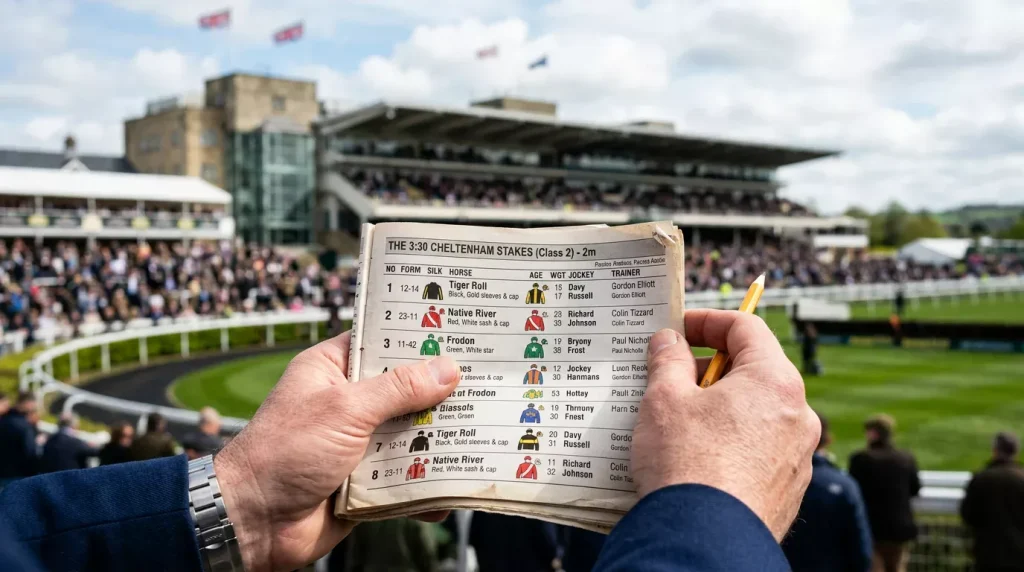
Contents
The Racecard Holds the Answers — If You Know Where to Look
The first racecard I ever studied properly was for a Class 4 handicap hurdle at Uttoxeter on a grey Tuesday in November. I had been betting on horse racing casually for two years by that point, picking selections based on tipster recommendations and the occasional gut feeling about a horse’s name. The racecard changed everything — not because it handed me winners, but because it revealed how much information I had been ignoring. Every column, every abbreviation, every string of numbers and letters encodes a piece of the puzzle. The punters who decode it consistently hold an edge over those who skip straight to the odds.
Win bets account for about 36% of all wagers placed on UK horse racing, and each-way bets add another 22%. The majority of that money is staked by people who look at the form page for no more than a few seconds before choosing a horse. They glance at recent finishing positions, maybe check the jockey’s name, and move on. The racecard offers twenty or more data points per runner. Using even half of them puts you ahead of the crowd.
This guide walks through the racecard from left to right, explains every element in practical terms, and then applies the whole framework to a worked example. By the end, you will read form the way a mechanic reads a dashboard — not just noticing the warning lights, but understanding what each gauge means for the engine underneath.
Anatomy of a Racecard: Every Column Explained
Racecards vary slightly between providers, but the core information is standardised across Racing Post, At The Races, and the official BHA racecard. I will walk through the columns in the order they typically appear.
Draw number. Relevant only on the Flat. This is the stall position from which the horse breaks. On certain courses — Chester, Beverley, and some configurations at Ascot — the draw has a measurable impact on results. On straight tracks, low draws often favour at some courses while high draws favour at others, depending on the rail position and camber. In National Hunt racing, there is no draw because horses start from a tape or flag.
Cloth number and silks. The number the horse carries on the raceday, matched to the owner’s colours. Useful mainly for identifying horses during a live stream or at the course. The cloth number also appears on the betting boards and in the starting price returns.
Horse name, age and sex. The name is obvious. Age is expressed in years (a horse born in any calendar year is considered one year older on 1 January of the following year). Sex is abbreviated: c for colt, f for filly, g for gelding, h for horse (an entire male aged five or older), m for mare. Age and sex influence expectations — a four-year-old gelding running against older horses in a handicap hurdle is on a different trajectory from a nine-year-old mare with 60 career starts.
Form figures. The string of numbers and letters immediately beside or below the horse’s name. This is the most information-dense element on the card and gets its own section below.
Days since last run. Some providers show this explicitly; others require you to calculate from the date of the last run listed in the form. Freshness matters: a horse returning after 20 days has had a quick turnaround, while one absent for 200+ days has been off for a reason — injury, a planned break, or a wind surgery. Neither is automatically good or bad, but both require context.
Trainer and jockey. Listed with recent form statistics on most modern racecards. A trainer’s strike rate at a particular course, in a particular class, or on a particular going is more predictive than their headline win rate. The jockey’s record with the specific trainer — their partnership strike rate — is often the single most useful quick-reference statistic on the card. For a deeper look at how to use these numbers, my trainer and jockey statistics guide covers the methodology in detail.
Weight carried. In handicaps, the weight is assigned by the official handicapper based on the horse’s rating. Higher-rated horses carry more weight. In non-handicap races, weight is determined by age and sex allowances. The key interpretive question is whether a horse is well-handicapped — carrying less weight than its recent form suggests it deserves — or poorly handicapped, lugging a burden that reflects past glory rather than current ability.
Official Rating (OR). The BHA handicapper’s assessment of the horse’s ability, expressed as a number. A higher number means a better horse. In handicaps, the OR determines the weight. In non-handicap races, the OR tells you the class level the horse has been competing at. Comparing ORs across runners gives a rough sense of the quality gap in the field.
Headgear. Blinkers, cheekpieces, tongue tie, visor, hood. Each has a different purpose — blinkers restrict peripheral vision to keep a horse focused; cheekpieces partially restrict it; a tongue tie prevents the horse from getting its tongue over the bit and restricting airway. First-time application of headgear is a significant positive signal in some cases, particularly first-time blinkers on unexposed horses. The racecard usually marks this with a small symbol or abbreviation.
Odds. The current market price, updated in real time on digital racecards. The odds encode the market’s collective assessment of probability, including the bookmaker’s overround. They are not the final piece of the puzzle — they are the output of everyone else’s puzzle-solving, and your job is to find spots where that output is wrong.
Reading Recent Form Figures: What the Numbers and Letters Mean
A form line of “2131-45” looks like a phone number until you know the code. Each digit represents a finishing position in a previous race, read from left to right with the most recent run on the far right. A hyphen separates the current season from the previous one. Letters replace numbers when the horse did not finish in a placing position, and each letter tells a specific story.
Numbers 1-9 are straightforward finishing positions. A “1” means the horse won; a “9” means it finished ninth. Positions of tenth and beyond are shown as “0” — which can be misleading, since a tenth of fourteen in a competitive handicap is a very different performance from a tenth of eleven in a weak novice hurdle.
F means fell. In National Hunt racing, this is common and not necessarily a mark against the horse’s ability — a talented jumper can fall at any fence on any day. What matters is frequency: a horse with two Fs in its last five runs has a jumping problem. One F in twenty runs is within normal range.
U means unseated rider. The horse did not fall but the jockey came off, typically at a fence or hurdle. Similar to F in its implications but can also indicate the horse jumped violently to one side.
P means pulled up. The jockey stopped riding because the horse was either too far behind to compete, was not travelling well, or appeared lame. A pull-up is a bigger concern than a fall because it implies the horse was unable or unwilling to complete the race even without a jumping error.
R means refused — the horse declined to jump a fence or start the race. Repeated refusals are a serious temperament issue.
C means carried out — the horse was taken out of the race by another horse’s fall or interference.
B means brought down — similar to C, the horse fell because of another horse’s mistake rather than its own.
The dash between seasons is critical context. A form line of “111-654” shows a horse that won three straight last season and has failed to reproduce that form this term. That decline could be caused by a rise in class, a change in going, an injury, or simply a horse that has lost its edge. Without the dash, you might misread the trajectory.
Course and distance form is highlighted on most racecards with abbreviations like “CD” (has won at this course and this distance), “C” (course winner), or “D” (distance winner). A horse with “CD” next to its name has proven it handles the specific demands of the track and trip — that is a harder filter to pass than general form and should carry weight in your assessment.
Going and Ground: How Conditions Change Everything
I once backed a horse that had won its last three starts on good-to-firm ground. The racecard for the day showed the going as heavy. I told myself it was “adaptable.” It finished last, beaten 40 lengths, slogging through mud it clearly hated. The going is not background noise — it is one of the most powerful predictive variables in horse racing, and ignoring it is like ignoring the weather forecast before sailing.
The official going scale in the UK runs from hard through firm, good-to-firm, good, good-to-soft, soft, to heavy. Some courses add “yielding” between good and soft. The going is assessed by the clerk of the course using a penetrometer (a device that measures the resistance of the ground) and visual inspection. It can change within hours if rain arrives, and racecards posted in the morning may not reflect conditions at post time.
Horses have ground preferences that are often as fixed as their temperament. A horse bred for speed on firm ground has flat, efficient action that does not cope with deep, holding going. A stamina-laden stayer bred for soft conditions has a round, high-knee action that generates lift in mud but wastes energy on fast surfaces. These preferences are embedded in the pedigree and confirmed by race results on different going descriptions.
Reading going preference from form is straightforward in principle: look at the horse’s finishing positions and match them against the going recorded for each race. A horse that finishes 1, 2, 1 on soft and 7, 9, 6 on good-to-firm has an obvious ground preference. The complication arises when the sample is small — a horse with only two runs on soft may not have confirmed anything yet — or when the going description is borderline (good-to-soft can behave like soft on one course and like good on another, depending on the soil type and drainage).
Trainers sometimes target specific going conditions deliberately, waiting weeks or months for the right ground before running a horse. If a horse has been off for a long time and declarations are made on a day when conditions match its preference, that is a signal worth noting. The trainer has been patient for a reason.
Class, Distance and Weight: The Triangulation That Picks Winners
Class, distance, and weight form a triangulation that filters contenders more reliably than any single factor. Get all three right and you are looking at a short list. Miss one and the entire assessment falls apart.
Class in UK racing is structured from Class 1 (Group and Graded races at the top) down to Class 7 (the lowest level of Flat racing). The average turnover per race in Premier Fixtures — where the top-class racing takes place — grew 2.7% in the first three quarters of 2026, while turnover in Core Fixtures dropped 8.6% over the same period. That divergence reflects a simple truth: quality attracts money, and higher-class races draw more public attention, sharper markets, and tighter overrounds. From a form-reading perspective, a horse dropping in class (moving from Class 3 to Class 4, for example) faces weaker opposition and its previous form may be undervalued by a market that fixates on recent finishing positions without adjusting for the quality of competition.
Distance is measured in furlongs (one furlong equals 220 yards, or about 201 metres) and miles. A horse’s optimal trip is determined by breeding, running style, and race record. Sprinters (5-6 furlongs) need explosive speed. Middle-distance horses (1 mile to 1 mile 2 furlongs) balance speed with stamina. Stayers (1 mile 4 furlongs and beyond) rely on endurance and the ability to maintain a gallop over extended distances. Stepping up or dropping down in trip is a common tactical move by trainers, and the form reader’s job is to judge whether the horse’s running style and pedigree suit the new distance. A horse that consistently finishes strongly over a mile, gaining ground in the final furlong, may be crying out for an extra two furlongs. A horse that leads early but weakens in the final stages may need to drop back in distance.
Weight in handicaps creates an equalising mechanism that makes these races the most challenging to read and the most rewarding to decode. The handicapper’s goal is a dead heat — every horse carrying the weight that reflects its ability, so that the worst horse on paper has theoretically the same chance as the best. In practice, the system is imperfect. Horses improve and regress between handicap assessments. A horse on an upward trajectory may be “ahead of the handicapper,” carrying less weight than its current form deserves because the rating has not yet caught up. Spotting these horses — often lightly raced four- and five-year-olds making their third or fourth handicap start — is one of the most consistently profitable form-reading angles.
The triangulation works like this: does the horse handle this class level (or is it dropping/rising)? Does the distance match its proven range? Does the weight allow it to compete on these terms? If all three answers are positive, the horse is a contender. If one is negative, the risk increases sharply. If two are negative, move on.
Speed Ratings and Sectional Times
Form figures tell you where a horse finished. Speed ratings tell you how fast it ran to get there. A horse that won a Class 5 handicap by six lengths in a slow time has achieved less than a horse that finished third in a Class 3 handicap in a fast time. Raw finishing positions cannot distinguish between these two performances. Speed ratings can.
The principle is simple: measure the time a horse took to complete the race, adjust for the going (faster ground produces faster times), adjust for the weight carried, and compare against a standard time for the course and distance. The result is a number that represents performance independent of class, competition quality, or race pace. Several providers publish speed ratings alongside standard form: Racing Post Ratings, Timeform, and specialist services that focus exclusively on sectional timing data.
Sectional times take the concept further by splitting the race into segments — typically measured at two-furlong intervals — and showing how the horse performed at each stage. A horse that clocked a fast final two furlongs while decelerating through the middle section has a different profile from one that ran even splits throughout. Sectional data is particularly valuable in Flat racing, where pace analysis reveals whether a horse was flattered by a slow early pace (allowing it to finish fast relative to tiring rivals) or produced a genuinely strong finishing effort.
The BHA projects that the number of races staged in Britain will be 6-7% lower by 2027 compared with 2026 levels. Fewer races mean fewer data points per horse per season, which makes speed ratings more important, not less — they extract maximum information from each run, compensating for the shrinking sample of appearances.
I use speed ratings as a filter rather than a primary selector. If a horse’s best speed figure in its last three runs is ten pounds below the average needed to win this class of race at this course, it is an underdog regardless of what the form figures suggest. If its best figure is five pounds above the class average, it deserves closer attention. Speed ratings do not replace form reading — they enrich it, adding a quantitative layer to the qualitative assessment that form figures, going, class, and distance already provide.
Worked Example: Breaking Down a Real Racecard
The British Horseracing Authority noted that there was much to be pleased about in 2026, with major meetings and races performing strongly — and those events, with their deep fields and high-quality runners, are exactly where form reading pays the highest dividends. Let me walk through a realistic example to show how the elements connect.
Imagine a 2-mile Class 3 handicap hurdle at Newbury, going described as soft. Eight runners declared. You open the racecard and focus on one entry: a six-year-old gelding with the form line “3121-43”, carrying 11 stone 2 pounds off an Official Rating of 132, trained by a handler with a 19% strike rate at Newbury over hurdles, ridden by a jockey who has a 24% strike rate for this trainer. First-time cheekpieces applied.
Start with the form figures. The most recent run was a third (the “3” on the far right). Before that, a fourth. Before the season break (the dash), the horse won, then finished second, won again, and finished third. The trajectory last season was upward; this season’s runs have been below that level. The question is why.
Check the going for each previous run. Suppose the two wins last season were on soft and heavy, while the fourth and third this season were on good-to-soft and good. That is a horse whose form correlates strongly with testing ground. Today’s soft going is a tick in its favour.
Now class and distance. The horse is running in Class 3 today. Its wins came in Class 4. The drop from last season’s form could partly reflect the step up in class this term. But the OR of 132 suggests the handicapper believes the horse belongs in Class 3 — that rating was earned by the strong performances last season. Two miles at Newbury over hurdles is a stiff test that demands stamina on soft ground. The horse has won over two miles on soft, so course and distance preference is at least partially proven.
Weight: 11 stone 2 pounds. In an eight-runner handicap with a weight range of, say, 11-7 to 10-0, this horse is near the top. It is well-handicapped only if you believe its current rating understates its ability — which the trainer might believe, given the application of first-time cheekpieces. That headgear signal suggests the connections think the horse has more to offer and are trying to unlock it with a change of equipment.
Trainer-jockey stats: 19% at this course and 24% as a partnership. Both above average. The jockey booking is intentional, not a default — this trainer has chosen a rider with a proven record at the track.
Speed rating: suppose the horse’s best hurdle figure is a 138 on soft ground, achieved when winning a Class 4 last season. The average winning speed figure for Class 3 handicap hurdles at Newbury on soft is around 135. The horse has run to a figure good enough to win this class, on this ground, at this course. That is the speed-rating filter passed.
The synthesis: ground suits, distance suits, class is a slight step up but the speed figure supports it, the trainer-jockey combination is strong at this course, and first-time cheekpieces add an equipment angle. The horse is not a certainty — no horse ever is — but it meets every criterion in the triangulation. If the market prices it at 7/1 and your assessment gives it a 20% chance of winning, the expected value is positive. That is the process, applied from top to bottom of the racecard, on every runner, in every race you consider.
