
Forecast and Tricast Betting in Horse Racing: How to Predict Placed Finishes
 Available in US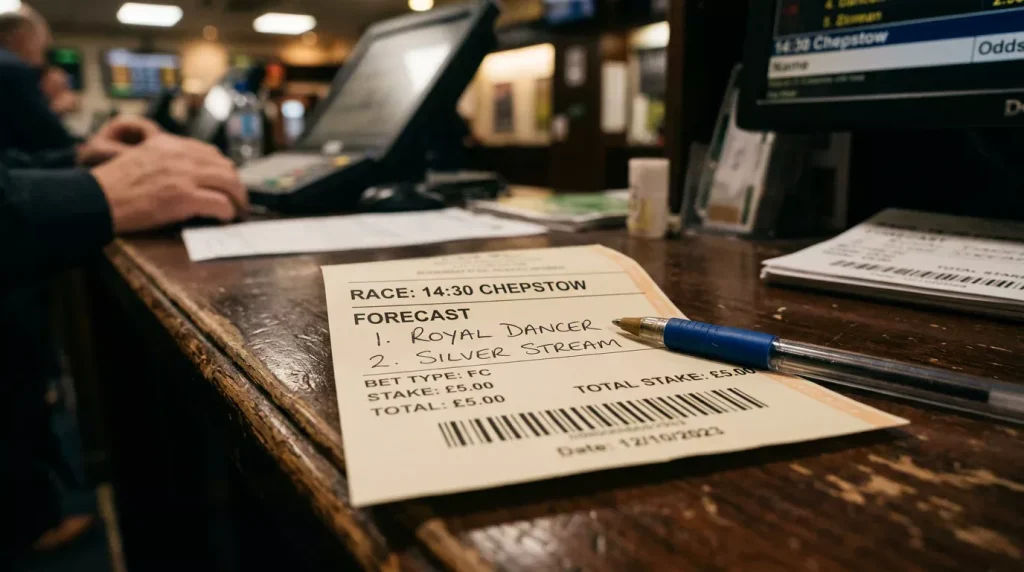
Contents
Forecasts and Tricasts Ask You to Predict the Exact Order — Here Is What That Costs and Pays
The biggest single return I ever had from a horse racing bet was a tricast. Three horses, exact order, 14-runner novice hurdle at Chepstow on a wet Wednesday afternoon. The payout was north of £800 from a £2 stake. It felt like genius at the time. What I did not calculate until later was how many losing tricasts I had placed in the months before that single hit. The net result over the whole period was roughly breakeven. Forecasts and tricasts are the high-wire acts of horse racing betting — spectacular when they work, costly when they don’t, and misunderstood by most of the people who play them.
These bet types account for a combined 17% of the UK horse racing betting market. That is a significant slice — bigger than multiples at 10% — which tells you there is real appetite for predicting the order of finish. Understanding how forecasts and tricasts work, and when they carry value, separates the informed punter from the casual dreamer.
Straight, Reverse and Combination Forecasts Explained
A straight forecast asks you to name the first and second in the correct order. You pick Horse A to win and Horse B to finish second. If they reverse positions — Horse B wins and Horse A is second — you lose. A reverse forecast covers both permutations: A-B and B-A. It costs twice the stake of a straight forecast because it is two bets.
A combination forecast (sometimes called a perm forecast) covers every possible order of two selections from three or more horses. If you pick three horses in a combination forecast, that generates six permutations (A-B, B-A, A-C, C-A, B-C, C-B) and costs six times your unit stake. Select four horses and the permutations jump to twelve. The more horses you include, the greater your coverage but the higher the total cost.
The payout on a forecast is calculated in one of two ways. A fixed-odds forecast shows you the potential return before the race, based on each horse’s individual odds. The Computer Straight Forecast (CSF) is determined after the race by a formula that accounts for the actual starting prices of all runners, the number of runners, and the result. CSF returns can be higher or lower than fixed odds depending on how the market shaped up. In competitive fields where the first two home were both unfancied, the CSF can produce returns that dwarf what the fixed-odds market offered.
Tricast Mechanics and When to Use Them
A tricast extends the forecast principle to three horses in exact finishing order — first, second, and third. The difficulty escalates sharply. In a 12-runner race, there are 1,320 possible tricast combinations. Your single straight tricast is one of those 1,320. The probability is low, and the returns reflect it — tricast dividends in competitive handicaps routinely run into hundreds or thousands of pounds from modest stakes.
Combination tricasts work the same way as combination forecasts: pick three or more horses and cover every possible arrangement. Three horses generate six straight tricasts (3 x 2 x 1 = 6). Four horses generate 24. The cost scales fast, and I have seen punters burn through bankroll on combination tricasts without realising they are placing dozens of bets per race.
When do tricasts carry genuine value? In races where you have strong opinions about three horses but the market has not identified the same trio. If the favourite is overbet and you believe two longer-priced runners will fill the places, a tricast around those selections can deliver returns that accumulator bets cannot match for the same outlay. The key is selectivity — one or two tricast bets per week on carefully analysed races, not a tricast on every card.
Field Sizes and Race Types That Suit Forecast Betting
Small fields and forecasts do not mix well. In a four-runner race, the CSF dividend is compressed because the mathematical formula discounts the limited number of outcomes. A 4/1 shot beating a 2/1 shot in a small field might return only slightly more than a straight win bet. The excitement of predicting the order is not matched by the reward.
Medium-sized fields — 8 to 14 runners — are the forecast sweet spot. Enough runners to generate meaningful dividends, but few enough that form analysis can narrow the likely first and second. Handicaps in this range often produce forecasts where the top two finishers are both in the 5/1 to 12/1 range, and the CSF pays substantially more than either horse would have returned as a win single.
Big-field handicaps with 20+ runners are tricast territory. The field is too open for a reliable forecast, but if you can isolate five or six contenders from 20 runners, a combination tricast across those selections offers multiple paths to a large return. The cost is higher — a combination tricast on five horses is 60 bets — but the potential dividend can justify it on the right race. Premier fixtures, where turnover per race has been climbing, often feature the most competitive handicaps and therefore the most rewarding tricast pools.
Class races — Listed and Group events — suit straight forecasts when one horse clearly outclasses the field and the real question is which of two or three others finishes second. A straight forecast with the class horse on top and a value pick for second can pay better than an each-way bet on the same two selections, with less total outlay.
Avoid using forecasts and tricasts as entertainment bets — random selections thrown at big fields in the hope of a windfall. The house edge on untargeted forecast betting is punishing because you are adding layers of difficulty without adding any analytical advantage. Every forecast and tricast you place should start from a position of genuine opinion about which horses will fill the top places and in what order. If you cannot articulate why your forecast is right, you should not be placing it.
