
Horse Racing Glossary: Every UK Betting and Racing Term Explained
 Available in US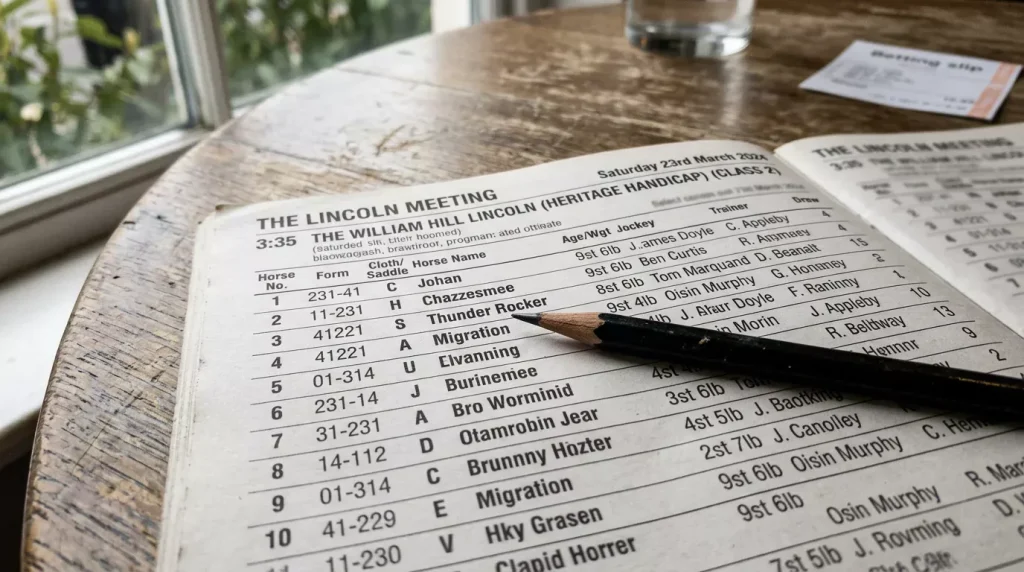
Contents
If You Have Ever Read a Racecard and Felt Lost, This Glossary Is Your Reference
I spent my first year of betting on horse racing pretending I understood what a “computer straight forecast” was. I nodded along when people mentioned “the going,” guessed at what “OR” meant on the racecard, and assumed NAP was an abbreviation for something technical rather than a tipster’s strongest selection. British horse racing is the second largest sport in the country after football by attendance, employment and revenue, and it comes with a vocabulary that has evolved over centuries. This glossary covers the terms you will encounter most frequently, split into betting terms and racing terms, so you can read a racecard, follow a tipster’s column and understand a commentator’s call without needing to decode the language first.
The sport generates £4.1 billion in annual economic contribution to the UK economy across 59 racecourses, and much of the language below is used daily by the more than 20,000 people employed directly in British racing. If a term appears in bold the first time you see it on this site, it is defined here.
Betting Terms: A to Z
Accumulator (Acca) — A single bet combining four or more selections. All must win for the bet to pay out. The odds multiply, creating large potential returns but very low probability of success. A four-fold accumulator on horses at 3/1, 4/1, 5/1 and 2/1 returns 359/1 plus your stake.
Ante-Post — A bet placed well before race day, often weeks or months in advance. Ante-post bets offer bigger odds but carry the risk of losing your stake if the horse does not run. See also NRNB.
Best Odds Guaranteed (BOG) — A bookmaker promotion where you take an early price and, if the starting price is higher, you are paid at the bigger odds. BOG effectively gives you a free upgrade and is standard across most major UK bookmakers for horse racing.
Bet Credits — Non-withdrawable funds added to your account as part of a welcome offer. Winnings from bets placed with credits are usually withdrawable, but the credits themselves cannot be cashed out.
Dead Heat — When two or more horses cannot be separated at the finish. Your returns are divided by the number of horses sharing the position. A dead heat for first between two horses means your winning bet pays at half the declared odds.
Double — A bet on two selections in different races. Both must win. The returns from the first winner roll onto the second.
Each-Way (EW) — Two bets in one: a win bet and a place bet. If your horse wins, both parts pay. If it places (finishes in the top two, three or four depending on field size and race type), the place part pays at a fraction of the win odds, typically 1/4 or 1/5.
Forecast — A bet predicting the first and second in a race in the correct order. A reverse forecast covers both possible orders. A combination forecast covers multiple permutations across three or more selections.
Free Bet — A bet funded by the bookmaker, usually as part of a sign-up offer. Stake is not returned with winnings in most cases.
Lucky 15 — Fifteen bets across four selections: four singles, six doubles, four trebles and one four-fold accumulator. At least one winner guarantees a return.
NAP — A tipster’s strongest selection of the day. The term comes from the card game Napoleon. A tipster’s second-strongest pick is called the NB (next best).
NRNB (Non-Runner No Bet) — A bookmaker term applied to certain ante-post markets. If your horse does not run, your stake is refunded. NRNB removes the non-runner risk of ante-post betting but typically at shorter odds.
Overround — The bookmaker’s built-in profit margin. If you convert all the odds in a race to implied probabilities and they sum to more than 100%, the excess is the overround. A 115% book means the bookmaker holds a theoretical 15% edge.
Patent — Seven bets on three selections: three singles, three doubles and one treble.
Rule 4 — A deduction applied to winning bets when a horse is withdrawn after the final declarations. The deduction amount depends on the odds of the withdrawn horse — the shorter the price of the non-runner, the larger the deduction from remaining winners.
Starting Price (SP) — The official odds of a horse at the moment the race begins, determined by on-course bookmakers. If you do not take a price, your bet settles at SP.
Tote — The UK’s pool betting operator. Rather than fixed odds, your return depends on how much money was bet into the pool and how it was distributed across runners. See also Placepot.
Tricast — A bet predicting the first three finishers in exact order. Available on races with eight or more runners in handicaps. Combination tricasts cover all possible orderings.
Racing and Form Terms: A to Z
Bumper — A National Hunt Flat race for horses that have not yet competed over hurdles or fences. Used to give young jumpers racecourse experience.
Chase — A race over steeplechase fences, which are larger and more solid than hurdles. Chasers must be at least five years old in Britain (four in Ireland).
Class — Races are graded from Class 1 (highest) to Class 7 (lowest). A horse’s class level indicates the quality of competition it faces. Dropping in class is often a positive sign; rising sharply in class without corresponding form is a warning.
Conditions Race — A race where entry conditions (age, sex, rating) replace a handicap weight system. Conditions races include Group and Listed events on the Flat and Graded races over jumps.
Form Figures — The sequence of numbers and letters after a horse’s name on the racecard. “1” means a win, “2” a second place, “0” means finished outside the first nine. Letters include F (fell), U (unseated rider), P (pulled up), R (refused), C (carried out). A dash separates different seasons.
Furlong — One-eighth of a mile, approximately 201 metres. The shortest Flat races are five furlongs; the longest National Hunt races exceed four miles (32 furlongs).
Going — The condition of the racing surface. On turf, the scale runs from firm through good to firm, good, good to soft, soft, and heavy. On all-weather, the terms are fast, standard and slow. Going is the single biggest variable in jump racing and a significant factor on the Flat.
Handicap — A race where horses carry different weights based on their Official Rating. The aim is to equalise chances: higher-rated horses carry more weight. Handicaps produce the most competitive fields and the biggest betting turnover.
Hurdle — A race over hurdle flights, which are smaller and more forgiving than chase fences. Hurdlers must be at least four years old in Britain.
Official Rating (OR) — A number assigned by the BHA handicapper reflecting a horse’s assessed ability. Higher means better. A horse rated 140 is elite; a horse rated 80 is modest.
Placepot — A Tote pool bet requiring you to select a horse to place in each of the first six races on a card. All six must place for the bet to win.
Sectional Times — Timing data for individual sections of a race rather than the overall time. Sectional times reveal whether a horse was finishing faster than its rivals even if it did not win, which is useful for identifying future winners from losing runs.
Speed Rating — A numerical figure expressing how fast a horse ran relative to a standard time for the course and distance, adjusted for conditions. Not the same as the Official Rating, which reflects overall ability rather than pure speed.
Stewards’ Enquiry — An investigation by the racecourse stewards into a potential rule breach during a race. Can result in a horse being disqualified or placed behind another runner, which affects betting results.
Trainer Form — The recent win and place record of a trainer, often expressed as a percentage over 14 days or the current season. Trainers in form tend to have their horses well and are worth following; a prolonged losing run can indicate yard problems.
