
Betfair Exchange vs Traditional Bookmakers: Which Gives Horse Racing Punters the Edge?
 Available in US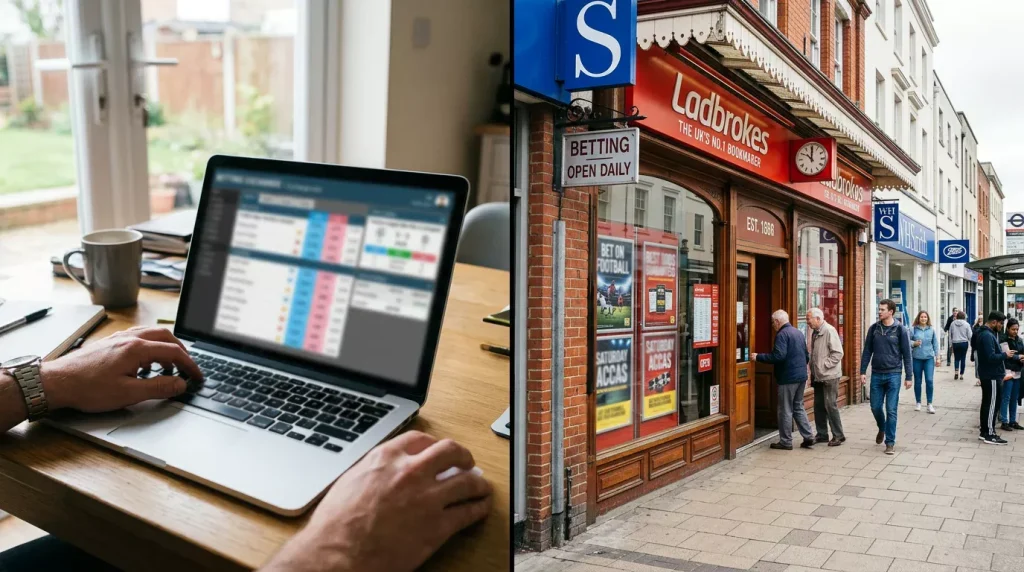
Contents
The Exchange Removed the Bookmaker from the Equation — but Added Complexity
The first time I placed a lay bet on the Betfair Exchange, I stared at the screen for ten minutes trying to work out which number was mine. Backing felt intuitive — you want the horse to win, you click the blue side. Laying was the opposite: I was betting against a horse, acting as the bookmaker, and the liability calculation was not something my brain processed naturally. That confusion cost me a clumsy 15-pound loss on a race I had analysed perfectly. The analysis was right. The execution was wrong.
The exchange model is fundamentally different from placing a bet with a traditional bookmaker. When you bet with a bookmaker, the firm sets the odds and takes the other side of your wager. Their margin — the overround — is baked into every price. When you bet on an exchange, you are matched against another punter. The exchange takes no position on the outcome; it simply charges a commission on your net winnings, typically between 2% and 5% depending on your activity level.
The remote betting sector generated a gross gambling yield of 2.6 billion pounds in the year to March 2026, with horse racing accounting for 766.7 million of that total. A meaningful slice of that horse racing figure flows through exchange markets, and the share has been growing as punters become more comfortable with the mechanics. Understanding when the exchange gives you a better deal than a bookmaker — and when it does not — is one of the most practical edges available to a UK racing punter.
Back, Lay and Liquidity: Exchange Mechanics
Backing on the exchange works like backing with a bookmaker: you want the horse to win, and if it does, you collect. The difference is that your bet is matched by another user who is willing to lay that horse — in other words, someone who thinks it will not win and is prepared to pay you if it does. The exchange displays available prices on both sides: blue for back, pink for lay. You can accept an existing price or request your own, which sits in the market until someone matches it or the race starts.
Laying is the mirror image. When you lay a horse, you are offering odds to someone who wants to back it. If the horse loses, you keep their stake. If it wins, you pay out at the agreed odds. Your liability on a lay bet is higher than your potential profit, which is the part that catches newcomers off guard. Laying a horse at 5.0 (4/1 in fractional odds) for a 10-pound stake means your liability is 40 pounds — the amount you would owe if the horse wins. Your profit if it loses is the 10-pound stake minus commission.
Liquidity is the practical constraint. On the biggest races — Cheltenham, Royal Ascot, the Grand National — exchange markets are deep, with hundreds of thousands of pounds matched. You can get on at the displayed price with no difficulty. On a Tuesday afternoon maiden at Catterick, the available money might be thin, and requesting a large stake at a specific price might leave you unmatched or only partially filled. I have learned to check the market depth before placing an exchange bet on any race outside the top tier. If the money is not there, the price is theoretical.
Margin Comparison: Exchange Commission vs Bookmaker Overround
This is where the maths tips in the exchange’s favour for many punters. A typical bookmaker overround on a six-runner race might be 115% to 120%. That means for every pound wagered across all outcomes, the bookmaker retains 15p to 20p as gross margin. The implied odds you are offered are worse than the true probability of each outcome. On a 3/1 shot in a market with a 118% overround, the true probability might be closer to 7/2 — but the bookmaker is offering 3/1 because the margin has been distributed across the field.
On the exchange, there is no overround in the traditional sense. The back and lay prices are set by the market — by other punters — and the spread between them is typically much tighter than a bookmaker’s margin. A horse available to back at 3.8 and to lay at 4.0 on the exchange represents a spread of roughly 5%, compared to the 15-20% overround in a bookmaker’s market. After commission of 2-5% on net profits, the effective cost of betting on the exchange is often still lower than the bookmaker’s built-in margin.
Flutter Entertainment, whose portfolio includes the exchange platform alongside traditional bookmaker brands, posted group revenue of 15.91 billion dollars for financial year 2026. That scale demonstrates the coexistence of both models: the exchange appeals to punters who want tighter margins and the ability to trade positions, while the bookmaker appeals to those who want simplicity, BOG promotions and the certainty of getting matched instantly.
One nuance worth noting: the commission rate you pay on the exchange is not fixed forever. Higher-volume traders often qualify for reduced rates, which further narrows the cost gap. If you are placing hundreds of bets per month, enquiring about loyalty-based commission discounts is worthwhile because even a one-percentage-point reduction compounds significantly across a season.
Scenarios Where the Exchange Beats Fixed-Odds
The exchange is at its strongest when you want to back a horse at a price better than any bookmaker is offering. On competitive handicaps with large fields, the exchange back price frequently exceeds the best available bookmaker price because the market is driven by punter supply and demand rather than a single firm’s risk model. I routinely check exchange prices before committing to a bookmaker bet, and on perhaps one in five occasions, the exchange is offering a full point or more of additional value.
Laying is the exchange’s unique advantage. There is no mechanism to lay a horse with a traditional bookmaker. If you believe a well-fancied horse will not win — maybe the ground is wrong, maybe the jockey booking is weaker than expected — the exchange lets you profit from that opinion directly. I use lay bets sparingly, but when a heavily backed favourite has a clear vulnerability that the market has not priced in, laying offers a way to capitalise that simply does not exist elsewhere.
Trading — backing at one price and laying at another to lock in a profit regardless of the outcome — is another exchange-only strategy. If you back a horse at 6.0 and its price shortens to 4.0 before the race, you can lay it at 4.0 and guarantee a profit whichever horse wins. This requires constant market monitoring and fast execution, so it is not for casual punters, but for those willing to invest the time, it turns horse racing into something closer to a financial market. For a broader look at how price differences across platforms affect returns, the odds comparison guide covers the topic in depth.
Scenarios Where Fixed-Odds Come Out Ahead
Best Odds Guaranteed is the bookmaker’s trump card, and it is one the exchange cannot match. When you take an early price with a bookmaker offering BOG, you are guaranteed the higher of your price and the SP. On the exchange, the price you take is the price you get — there is no mechanism for an automatic upgrade. I have had weeks where BOG upgrades across multiple bookmaker bets added more value than the tighter exchange margins would have saved me.
Simplicity counts for something too. Placing a bet with a bookmaker takes thirty seconds: select the horse, enter the stake, confirm. Exchange betting introduces additional decisions — should I take the available back price or request a better one? Is there enough liquidity for my stake? Should I trade out before the off or let it run? For a casual Saturday punter who bets on three or four races and wants to watch them without monitoring a trading screen, the bookmaker experience is materially easier.
Promotional offers tilt further toward bookmakers. Free bets, enhanced odds, acca boosts and money-back specials are standard fare across the traditional betting industry. The exchange offers very few comparable promotions because its revenue model is based on commission, not on the outcome of individual bets. A new customer opening accounts with several bookmakers and using each welcome offer intelligently can generate genuine value that exchange betting cannot replicate.
Finally, the exchange can be inhospitable for very casual or very small-stake bettors. If you are betting two or three pounds per race, the commission on small net winnings rounds to fractions of a penny and the experience is not noticeably cheaper than a bookmaker. The exchange’s cost advantage scales with volume. For low-frequency punters, the bookmaker’s all-in simplicity is hard to beat.
