
Grand National Best Bets: How to Find Value in the World’s Most Famous Race
 Available in US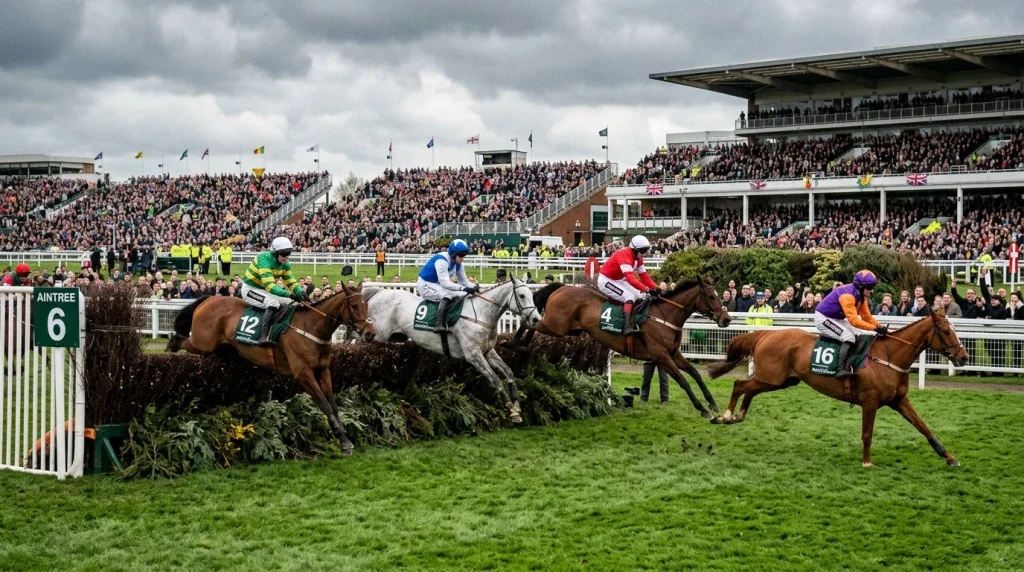
Contents
Forty Runners, One Fence-Strewn Gauntlet: What Makes Grand National Betting Unique
I have watched the Grand National from the Canal Turn twice, and the thing that stays with you is not the speed or the spectacle — it is the noise of forty horses landing on the other side of a birch fence at the same moment. The ground shakes. You feel it in your ribs. It is a reminder that this race is not like any other, and the way you bet on it should not be like any other either.
The Grand National is the single biggest betting event on the UK racing calendar. More money is wagered on this one race than on any other individual sporting contest in Britain. UK racing attendance reached 5.031 million across 2026 — the highest since 2019 — and the Aintree Grand National meeting accounts for a significant chunk of that figure in just three days. For millions of people who never place a bet the rest of the year, the National is the one race where they pick a horse, put a fiver on, and watch.
That massive casual participation distorts the market in ways that create genuine value for anyone willing to do the work. When millions of once-a-year punters pile into the market based on a horse’s name or colours rather than form, the prices on less fashionable runners can drift beyond their true probability. Finding those runners is where the edge lies.
The Statistical Profile of a Grand National Winner
Over the past twenty years, Grand National winners share a remarkably consistent profile. Knowing that profile does not guarantee you will find the winner, but it eliminates a large chunk of the field before you even look at the form.
Age is the first filter. Winners overwhelmingly come from the eight to ten year-old bracket. Younger horses lack the experience for a race of this complexity; older horses tend to lack the stamina and recovery speed for four miles and two furlongs over thirty fences. If you are considering a horse outside the 8-10 age range, you need a very strong reason.
Weight is the second filter. The Grand National is a handicap, and the relationship between weight and finishing position is well documented. Horses carrying above 11st 5lb have a poor record in recent decades. The top weight rarely wins. The sweet spot sits between 10st 4lb and 11st, where the horse is good enough to be competitive but not burdened by a mark that reflects top-class form.
Previous experience over the National fences is the third filter. Horses that have run at the Aintree Grand National meeting before — whether in the Topham or the Becher Chase or a previous National — consistently outperform debutants. Betting participation rises to around 7% of UK adults during the major festival months, and much of that money lands on horses with name recognition but no course experience. Filtering for Aintree form immediately narrows your shortlist.
Stamina is the fourth filter. Proven form at three miles or further over fences is non-negotiable. A horse that has won a two-mile-five chase and is stepping up in distance might have the talent, but the National demands four miles of jumping on terrain that tires horses through the back straight in a way no other race does. Look for runners that have won or placed in long-distance chases at Cheltenham, Haydock or Newbury.
Why Each-Way Dominates Grand National Betting
Win bets make up 36% of the general horse racing market, but in the Grand National, each-way betting takes over. The reasons are structural. With forty runners, the bookmakers typically pay four places (sometimes more as a promotional enhancement), and the place odds at a quarter of the win price can return a decent profit even if your horse finishes second, third or fourth.
Consider a horse at 25/1 each-way. The win part pays 25/1 if it finishes first. The place part pays 25/4 — which is 6.25/1 — if it finishes in the first four. A ten-pound each-way bet costs twenty pounds total. If the horse finishes third, the win part loses (minus ten pounds) but the place part returns 72.50 (6.25 x 10 + 10 stake). Net profit: 52.50 from a horse that did not even win. That arithmetic is why experienced punters treat the National as an each-way puzzle rather than a win-bet problem.
The large field also means you can have two or three each-way selections without the bets conflicting. Unlike a six-runner novice chase where backing two horses each-way is redundant, a forty-runner handicap gives each selection enough room to perform independently. I typically have two each-way bets in the National — one at a shorter price with strong place credentials, and one at a bigger price with a profile that matches the historical winner template. If both place, the day is profitable regardless of who wins.
Ante-Post or Day-of: When to Strike
Timing your Grand National bet is its own skill. Ante-post prices are available from months in advance, and the biggest moves happen in two phases: after the weights are published (usually in February) and in the final week when the declarations are confirmed.
Alan Delmonte of the Horserace Betting Levy Board observed that the Cheltenham period saw bookmakers’ gross profits well above recent norms, a reflection of the sport’s essential unpredictability. That unpredictability applies equally to the Grand National, where ante-post punters accept the risk of non-runners in exchange for substantially better odds. I have taken 40/1 on National runners in January that started at 14/1 on race day. The non-runner risk is real — horses get injured, ground conditions change, trainers reroute — but the price compression over those months is consistently dramatic.
If you prefer to bet on the day, the morning of the race is the key window. Prices stabilise around mid-morning as the market absorbs the final jockey bookings, going reports, and pre-race commentary. The starting price is generally a fair reflection of the market’s final assessment, but it does not always match the morning price. BOG covers that gap if your bookmaker offers it, and for the National specifically, it is worth confirming that your chosen firm’s BOG applies to the race — some restrict or modify their terms for the National due to the scale of liability. For more on navigating these terms, the Cheltenham betting guide covers similar dynamics for that meeting.
Filtering the Field: A Practical Shortlisting Method
My Grand National method is a process of elimination, not inspiration. I start with the full forty and remove horses that fail any of the four statistical filters: wrong age range, too much weight, no Aintree experience, insufficient stamina form. That usually cuts the field to twelve or fifteen. From there, I look at recent form — specifically, the last three runs, with emphasis on how the horse jumped and whether it finished its races strongly or weakened.
Trainer intent matters at this stage. A horse whose trainer has targeted the National — running it over three miles at Haydock in January, then the Becher Chase in December, then a final prep at Kelso or Doncaster — is being prepared specifically for this race. A horse shoehorned into the National after a season aimed at the Gold Cup or the Stayers’ Hurdle is less likely to be at peak fitness for the unique demands of four miles over Aintree’s fences.
By race week, I am down to four or five horses. Two get each-way bets at the best available odds. The others go on a watch list for next year, because the Grand National rewards patience and pattern recognition. The horse that finished sixth this year carrying 10st 8lb with clean jumping is exactly the type that wins next year off a similar weight with another twelve months of experience. Keeping notes year to year turns the National from an annual gamble into an ongoing research project — and research, in my experience, is the only reliable route to value in a race this complex.
